Theory of Change Explorer
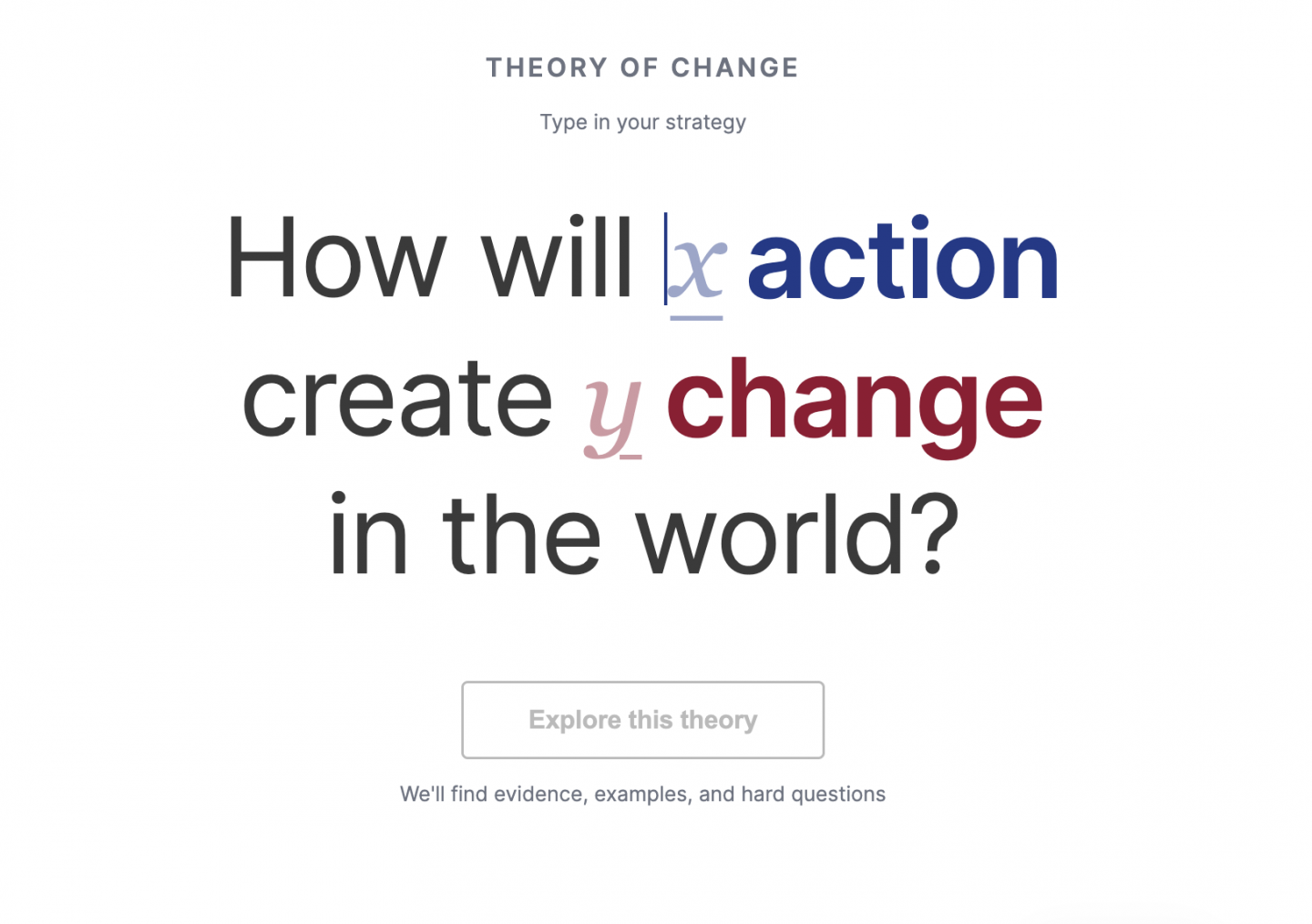
The Theory of Change Explorer is a free tool that lets users type in a planned action and an intended outcome, then generates an analysis of the causal link between the two — drawing on existing evidence, organising history, and the hidden assumptions that often sit unexamined inside a theory of change.
Theory of Change is a planning and evaluation methodology developed in the early 1990s by Carol Weiss and colleagues at the Aspen Institute's Roundtable on Community Change. It has since become a cornerstone of how Civil Society plans and evaluates its work, but the process of actually stress-testing a theory of change is often manual and time-consuming.
The tool was originally built by Matt Stempeck, Head of Democracy & Technology at the Evens Foundation, to support graduate students working on political technology projects. Seeing its wider relevance, the Foundation made it publicly available to the broader Civil Society community. It is open source, so any organisation can remix or redeploy it for its own purposes.
Rather than generating generic outputs, the Explorer connects users to relevant real-world resources within the Civic Tech Field Guide, grounding its analysis in the practical experience of the field.
The project sits within the Foundation's wider programme of public experiments exploring how AI can serve Civil Society constructively, following an earlier experiment using AI to analyse foresight reports. It reflects an interest in interrogating what AI can add to democratic and civic work, rather than what it can replace: supporting habits like self-reflection and critical analysis, instead of bypassing them.
The Theory of Change Explorer is a free tool that lets users type in a planned action and an intended outcome, then generates an analysis of the causal link between the two — drawing on existing evidence, organising history, and the hidden assumptions that often sit unexamined inside a theory of change.
Theory of Change is a planning and evaluation methodology developed in the early 1990s by Carol Weiss and colleagues at the Aspen Institute's Roundtable on Community Change. It has since become a cornerstone of how Civil Society plans and evaluates its work, but the process of actually stress-testing a theory of change is often manual and time-consuming.
The tool was originally built by Matt Stempeck, Head of Democracy & Technology at the Evens Foundation, to support graduate students working on political technology projects. Seeing its wider relevance, the Foundation made it publicly available to the broader Civil Society community. It is open source, so any organisation can remix or redeploy it for its own purposes.
Rather than generating generic outputs, the Explorer connects users to relevant real-world resources within the Civic Tech Field Guide, grounding its analysis in the practical experience of the field.
The project sits within the Foundation's wider programme of public experiments exploring how AI can serve Civil Society constructively, following an earlier experiment using AI to analyse foresight reports. It reflects an interest in interrogating what AI can add to democratic and civic work, rather than what it can replace: supporting habits like self-reflection and critical analysis, instead of bypassing them.